 The Orthodox Church confesses that God is one God in three Persons: the Father, the Son, and the Holy Spirit. This does not mean three gods, nor does it mean one God acting in three different roles. God is truly one in essence and truly three in Persons.
The Father is the source, the Son is eternally begotten of the Father, and the Holy Spirit eternally proceeds from the Father. This is not something God became, but who God is, eternal communion of love.
Since the Holy Trinity is a mystery and cannot be fully comprehended by our minds, we cannot figure out the Trinity on our own; therefore, God has revealed Himself: the Father sending the Son into the world, and the Holy Spirit given to the Church. This is why the Trinity is not a puzzle to solve, but a mystery to enter and accept in awe.
In Orthodox life, the Trinity is not an abstract idea but a personal God. We pray to the Father, through the Son, in the Holy Spirit. Every service, every blessing, every baptism is Trinitarian. To know God is to be drawn into this life of love and communion.
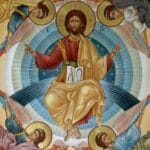
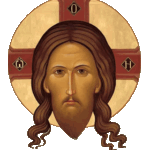 Orthodox Christians venerate icons because God became visible.
In the Old Testament, before Christ, God could not be depicted because He had not yet taken flesh. In Jesus Christ, the Son of God, truly became human. He was seen, touched, and lived among us. Because Christ took on a real human body, He can be depicted.
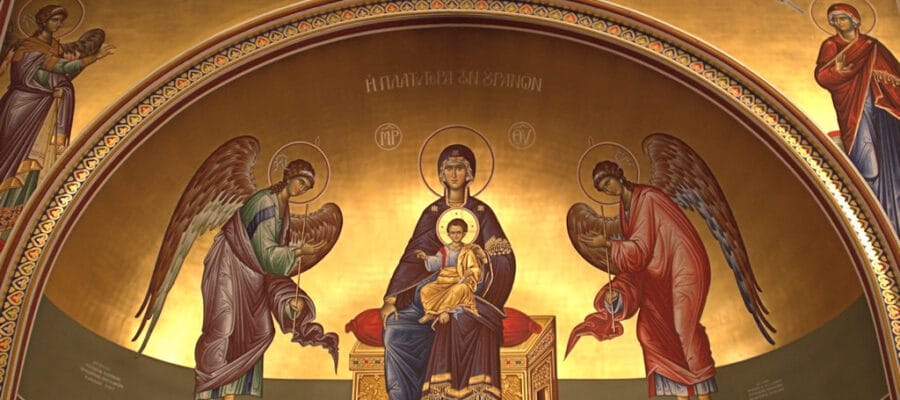
An icon is not a decoration, not just religious art, and definitely not an idol, but a theological statement: God has entered His creation and sanctified matter.
When Orthodox Christians venerate icons, they do not worship wood and paint. Worship belongs to God alone. The honor given to the icon passes to the person depicted, such as to Christ, to His Mother, or to the saints. This is the same reason we kiss the Gospel book or the Cross, not because they are objects, but because of what they reveal.
Icons teach us something important: matter is not evil. The physical world can carry the presence of God. Just as water becomes the means of Baptism, and bread and wine become the Eucharist, paint and wood can proclaim the Gospel.
Icons are windows into the Kingdom.
 In Orthodox Christianity, salvation is not primarily a legal transaction or a moment in time. Salvation is healing, restoration, and union with God.
Human beings were created for communion with God, but through sin, that communion was broken. Christ came not simply to cancel guilt, but to heal human nature itself. By His life, death, and resurrection, Christ destroys death from the inside and opens the way back to life with God.
Salvation is therefore a lifelong journey of repentance, a process, transformation, and growth in holiness. The Church calls this theosis: becoming, by grace, what God is by nature.
This does not mean becoming divine by essence, but being filled with God’s life. Through baptism, confession, the Eucharist, prayer, fasting, and love for others, we are slowly reshaped into the image of Christ.
Salvation is not something we do alone. It is life in Christ, within His Body, the Church.
 In Orthodox Christianity, the Church is not primarily an institution, organization, or building. The Church is the living Body of Christ in the world.
Christ is the head of the Church, and those who are united to Him through baptism, faith, and the Eucharist are members of His Body. The Church is both visible (in her worship, sacraments, and communities) and invisible (united to Christ and to the saints in heaven).
The Church does not exist merely to teach ideas or enforce rules. She exists to give life, to heal human beings, and to lead them into communion with God. To belong to the Church is to share in this life.
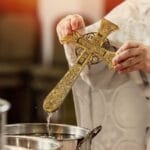 In Orthodoxy, the sacraments are called Mysteries because God’s work cannot be reduced to explanations. Through the Mysteries, God uses ordinary things, like water, oil, bread, wine, and spoken words, to communicate His grace. This shows that creation itself can be filled with God’s presence.
The Church traditionally speaks of seven Mysteries: Хрещення, Миропомазання, Eucharist, Confession, Marriage, Ordination, and Unction. But Orthodox Christians understand that God’s grace is not limited to a fixed number. The whole life of the Church is sacramental.
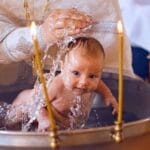 Baptism is not just a symbol or public declaration of faith. It is a true new birth. Through Baptism, people are united to Christ’s death and resurrection, their sins are forgiven, and they are brought into the life of the Church. This is why Baptism is done with water and immersion: it is a true participation in dying and rising with Christ.
Baptism marks the beginning of the Christian life, not its completion. It opens the door to a lifelong journey of growth, repentance, and communion with God.
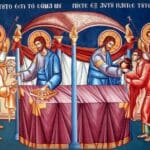 The Eucharist is the heart of Orthodox Christian life.
In the Divine Liturgy, bread and wine become the true Body and Blood of Christ, not symbolically, but truly and mysteriously. The Church does not attempt to explain how this happens; she simply receives Christ’s promise.
Holy Communion is not a private devotion but communion for the sake of union with Christ and with one another. This is why preparation, repentance, and reconciliation are essential parts of Eucharistic life. The Eucharist is heaven touching earth.
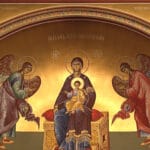 Orthodox Christians pray with the saints, not instead of God. They ask the saints to pray with them.
The saints are those who have finished the race of faith and now live fully in Christ. Because God is the God of the living, not the dead, the saints remain alive in Him and continue to love and pray for the Church on earth.
Asking the saints for their prayers is no different in principle from asking a fellow Christian to pray for us, except that the saints are already fully united to Christ. The Church on earth (us – the living) and the Church in heaven (the saints and all departed this life Christians) are not divided.
 The Bible is the inspired Word of God and is central to Orthodox life.
Orthodox Christians read Scripture within the Church, guided by the worship, the Church Fathers, and the lived faith of the community. The Bible did not come from outside the Church; it was received, preserved, and proclaimed by her.
Scripture is not simply a book to analyze or to master, but a voice that calls us to repentance, faith, and transformation.
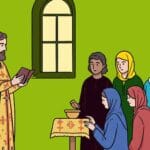 Holy Tradition is not only customs or human habits. It is the living memory of the Church, guided by the Holy Spirit. Tradition includes Scripture (yes, your Bible is a result of Tradition in power), the Ecumenical Councils, the writings of the Fathers, the liturgy, iconography, and the way the faith has been lived through the centuries.
Tradition does not trap the Church in the past. It keeps her faithful to Christ in every generation.
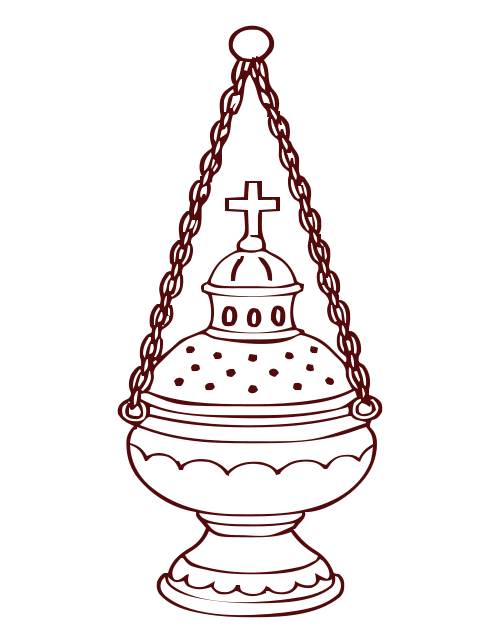 Orthodox worship involves the whole person: body, mind, and soul. During the Orthodox worship, we see, we hear, we smell, we bow, and we sing.
Incense, candles, chanting, and gestures are not decorations. They express prayer through the senses. Worship is not meant to be only intellectual; it is meant to be experienced. Incense rises like prayer. Candles express an offering. Chant carries Scripture into the heart.
These practices reflect the biblical vision of worship and remind us that we approach God with reverence, beauty, and humility.
 Fasting is spiritual training. It is not punishment or self-denial for its own sake. It is training for freedom from selfish desires.
By fasting from certain foods and habits, Christians learn to say no to selfish desires and yes to love, prayer, and generosity. Fasting is always connected to repentance, mercy, and care for others.
Without humility and mercy, fasting becomes empty; with them, it becomes healing. And it has always to be connected to love.
 The goal of the Christian life in Orthodoxy is union with God. Not just moral improvement. Not just rule-keeping. Not just information. Union.
This union is not achieved by human effort alone, but by cooperation with God’s grace. Through prayer, the sacraments, repentance, and love, the Christian is gradually transformed into the likeness of Christ.
This journey continues throughout life and is fulfilled in the Kingdom of God. The Church exists to guide her children along this path.