The Ancient Orthodox Secret to Trusting God
Trusting God sounds simple until life becomes unstable. It is...
Read More →
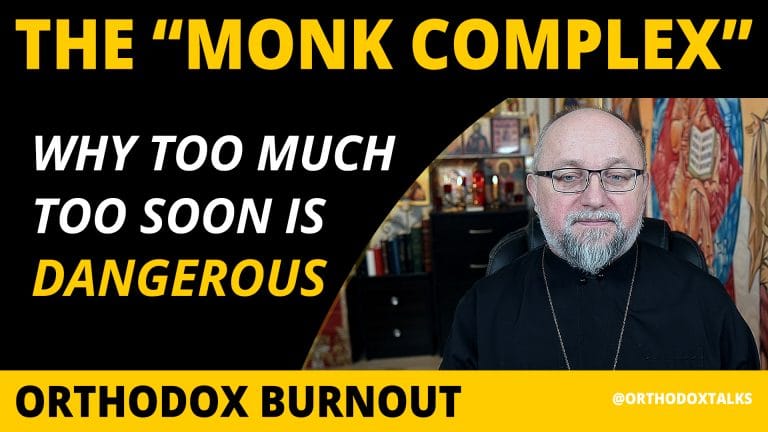
Today, we are exposing a particularly subtle and dangerous mistake that many novices make: the “monk or nun complex.” This often happens when you are first inspired by the lives of the great saints, like Saint Anthony the Great or Saint Mary of Egypt. You read about their incredible feats and think to yourself that if they did it, you should too. Suddenly, you are trying to fast on nothing but bread and water, waking up at 3:00 a.m. for a three-hour prayer rule, and essentially turning your apartment into a monastic cell.
The problem with this complex isn’t the desire for holiness—that is a good thing. The problem is the ego. When we set out these “super rules” for ourselves, we are essentially acting as our own spiritual fathers. We are deciding exactly how much heat we can handle without the years of obedience required to sustain it. I often compare spiritual growth to physical weightlifting. If you go to the gym and try to bench press 400 pounds on your first day, you won’t get strong; you’ll just tear a muscle and never want to step foot in a gym again. I have seen many people on fire for their first six months, only to disappear a year later because they tried to run a marathon at a sprinter’s pace. They made the faith a burden of “doing” rather than a relationship of “being” with God.
There is also a deep spiritual danger in this heroic strictness: it almost always leads to judging others. When you are keeping a perfect, difficult fast, it is nearly impossible not to look at the person next to you eating a cheeseburger on a Friday and feel superior. The Desert Fathers warn us constantly about this. They tell us it is far better to eat meat and remain humble than to eat nothing and be filled with pride. As a novice, your job isn’t to be the “best” or most “hardcore” Orthodox person in the parish; it is to be the most repentant one. If your prayer rule is making you grumpy, impatient with your spouse, or judgmental of your priest, then that rule is serving your ego rather than God.
To avoid this pitfall while still being serious about your faith, you must embrace the rule of obedience. Never take on a new fast or a longer prayer rule without asking your priest first. If he tells you to do less, listen to him. That act of simple obedience is worth more than a thousand prostrations. You must also remember that your current “monastery” is your daily life. If you are a student, a parent, or an employee, that is your primary spiritual work. Serving your family and doing your job with integrity is where you will find God.
Another vital practice is to keep your efforts hidden. When you are fasting or praying, do not talk about it. If people know how “holy” you are, you have already received your reward in their praise. Focus instead on consistency. It is better to do ten percent of a rule with consistency for years than to do a hundred percent for only ten days. Consistency is what slowly shapes the soul and allows you to add more when there is a true need, guided by your spiritual father.
The Church is not a gymnasium for spiritual athletes to show off; it is a hospital for the sick. Monastics are called to a very specific and intense form of warfare, but most of us are called to find God in the ordinary—in the patience we show in traffic and the kindness we offer our neighbors. Don’t try to become a saint overnight. Instead, be a faithful beginner every single morning. As Saint Herman of Alaska beautifully advised, from this day, from this hour, from this minute, let us love God above all. He didn’t say to fast perfectly; he said to focus on love and humility. The rest will come in God’s time.
Welcome home, and let’s get to work, humbly and slowly.
To watch the full video on the “Monk Complex,” click here.